




JetBoots PRO Plus Is Scientifically Proven to Enhance Performance & Recovery
Published:
Written by: Rachelle Reed, PhD, MS, ACSM-EP
Reviewed by Therabody scientists: Tim Roberts, MSc; Emily E. Munn, PhD, MEd
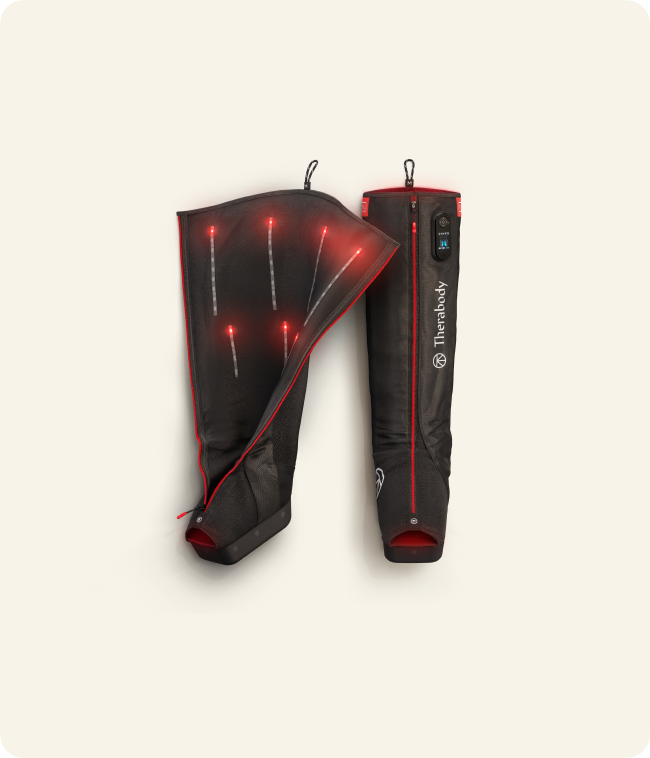
A new study finds that Therabody’s JetBoots® PRO Plus, a multi-therapy device that combines pneumatic compression with vibration and infrared LED light, is scientifically proven to reduce the effects of fatigue on performance, improve post-exercise swelling and inflammation, and improve muscle activation of the quadriceps in the days following training.
The study also shows that after using the device, participants felt recovered, energized, relaxed, and felt less pain in their quadriceps and hamstrings.
Learn more about how the study was conducted, what was uncovered, and why it matters for workout performance and recovery.

How does pneumatic compression work?
Pneumatic compression is a therapy that uses air pressure delivered through a pair of boots to compress the legs. [1]
Intermittent sequential pneumatic compression, the technology in Therabody’s JetBoots rhythmically inflates and deflates along the limb to move metabolic waste away from the tissues, while encouraging the delivery of blood and nutrients to the tissues. [2, 3, 4]
This technology mimics the muscle pump to support the movement of fluids (including blood) towards the heart. [2, 4]
In periods of high training and competition demands, optimal recovery can impact everything from winning a competition to decreasing injury risk. Several studies to date have shown that pneumatic compression can improve recovery following exercise. [4, 5]
No studies to date have investigated the impact of pneumatic compression combined with other performance and recovery modalities, like vibration and LED light therapy.
Why include pneumatic compression with vibration and LED light for athletic performance and recovery?
The JetBoots PRO Plus combines pneumatic compression with vibration and infrared LED light therapy, creating a 3-1 recovery tool. Combining treatments into a multi-therapy device enables efficiency and time savings by stacking treatment benefits.
Infrared light therapy: Infrared LED light can reach beneath the skin for therapeutic warming. This light therapy increases blood flow, reduces inflammation, and promotes healing at the cellular level. It can also help to relieve tension in tight muscles, helping them relax. [6]
Vibration therapy: Vibration therapy is a rhythmic, massage-like pressure applied to tight muscles that has been known to relieve pain for decades. Using vibration therapy can improve muscle strength and power, joint flexibility, and range of motion. [7, 8]
Efficiently delivering three modalities simultaneously may improve performance and recovery to a greater extent than any single one, while maintaining the treatment time of a single therapy.

How was the study conducted?
This study was a randomized, double-blind, parallel group trial. Participants were screened based on study inclusion and exclusion criteria. Participants who met the criteria and consented were randomly assigned to one of three recovery groups:
- Pneumatic compression + vibration + infrared LED light
- Pneumatic compression only
- Passive recovery (the control group)
Then, they participants completed five visits to the lab:
- Baseline (Day 0): Baseline assessments, bloodwork, and wellness outcomes (via survey) were measured.
- Exercise visit (Day 1): Participants completed an exercise induced muscle damage (EIMD) protocol, assessments, their assigned recovery method, followed by repeating assessments.
- Assessment and recovery visit (Days 2): Assessments, assigned recovery method, repeated assessments, and bloodwork.
- Assessment and recovery visit (Day 3): Assessments, assigned recovery method, repeated assessments, and bloodwork.
- Assessment and recovery visit (Day 4): Assessments, assigned recovery method, repeated assessments, wellness surveys, and bloodwork.
What did the study look at?
Primary study aims:
- Evaluate pneumatic compression as an effective modality for muscle recovery after an exercise-induced muscle damage protocol.
- Assess a combination approach (pneumatic compression + vibration + LED light) on performance and recovery, compared to pneumatic compression alone, and passive recovery.
- Understand immediate performance and recovery benefits (right after treatment) and benefits 24–72 hours after exercise.
Secondary study aims:
- Understand subjective changes in well-being, including sleep, stress, mood, and vitality.
- Analyze biochemical markers related to muscle damage, inflammation, and stress.
- Track and analyze changes in pain and discomfort using validated measurements.
- Monitor for adverse reactions or side effects.
Who were the participants?
Participants were recruited via email campaigns, on-campus advertising, and word-of-mouth. A total of 120 participants completed the study, with 40 participants included in each of the three study arms: pneumatic compression + vibration + LED light, pneumatic compression only, and passive recovery (the control group).
Eligible participants were healthy, regular exercisers aged 20–35 years who were free from metabolic or musculoskeletal disorders. Additional exclusion criteria included the use of muscle‑affecting medications, pregnancy, allergies to device materials, recent muscle strains or injuries, cardiovascular, respiratory, or neurological disorders, recent use of recovery modalities, or ongoing physical therapy.
At baseline, there were no meaningful differences between groups in age, body mass index (BMI), or sleep quality scores (p > 0.05). This is favorable, as it means all three groups are relatively similar.
Table 1: Participant Characteristics at Baseline
|
|
CONTROL (n = 40) |
ISPC (n = 40) |
ISPC+ (n = 40) |
|
Age |
25.08 ± 3.78 |
23.78 ± 4.86 |
24.58 ± 5.35 |
|
% Female |
62.5% |
50% |
70% |
|
Body Mass Index (BMI) |
24.09 ± 4.16 |
23.45 ± 2.75 |
23.37 ± 3.34 |
|
Sleep (PSQI*) |
5.35 ± 2.60 |
4.82 ± 2.40 |
5.28 ± 2.86 |
*PSQI: Pittsburg Sleep Quality Index
What assessments and markers were used?
EIMD protocol: The goal is to create a fatiguing workout to properly measure the body’s recovery response. Countermovement jumps are a valid and reliable measure of lower-body power, known to induce fatigue and muscle soreness. [9]
- Warm-up: 5 minutes of dynamic movement
- Exercise: 10 sets of 10 countermovement jumps with a 1-minute rest between sets
Physical and functional performance: Researchers used validated tests that assess lower-body power, strength, and swelling.
- Countermovement jump (CMJ)
- Squat jump (SJ)
- Limb circumference
- Strength (Knee Extension via Dynamometer)
Muscle activation: Evaluates muscle activation patterns, neuromuscular function, and recruitment during exercise using electromyography (EMG).
- EMG on 3 sites: Vastus Medialis (VM); Vastus Lateralis (VL); Rectus Femoris (RF)
Pain & soreness: These validated scales measure muscle discomfort and tenderness post-exercise
- Algometry (DOMS)
- Visual Analogue Scale (VAS): Quadriceps; Hamstrings
Perceptual recovery: Used to monitor feelings of recovery and training readiness.
- Perceived recovery status (PRS)
- Total quality recovery (TQR)
Wellness & vitality: Indicates vitality in general life and exercise-specific contexts.
- Subjective vitality scale (SVS): General life; Specific moment; Total life
Mood & engagement: Indicates engagement and enjoyment in physical activity, and its energizing and stress-reducing effects.
- Exercise-induced feeling inventory (EFI): Positive engagement; Revitalization; Tranquility; Physical exhaustion
Biomarkers: Blood markers that assess muscle damage, inflammation, and oxidative stress.
- Muscle damage: Creatine kinase (CK); Lactate dehydrogenase (LDH)
- Inflammation: Interleukin-6 (IL-6); Interleukin-1β (IL-1β)
- Oxidative stress: Dichlorofluorescin (DCF); Superoxide Dismutase (SOD); Glutathione (GSH)

JetBoots PRO Plus improved measures of athletic performance and recovery
JetBoots PRO Plus is scientifically proven to reduce the effects of fatigue on performance, lower post-exercise swelling, and improve muscle activation of the quadriceps in the days following training.
The device is also science-backed to help people feel better following exercise. Compared to participants in the control condition, JetBoots PRO Plus helps participants feel 32% more recovered, while increasing feelings of energy by 12% and relaxation by 40% after a single use.
Here, we’ll walk through exactly what the study found.
Physical and functional performance improved
After a single JetBoots PRO Plus session, participants' countermovement jump improved by 5% compared to their baseline, showing an immediate improvement in reducing the effects of fatigue on performance. This is significant, as during sports and in competitions, a 5% performance improvement is often a substantial competitive edge.
A single use of the device also helped to reduce post-exercise swelling, compared to their baseline, immediately following use, as measured by thigh circumference. Muscles typically swell after tough exercise bouts, and reducing swelling can signal recovery and may improve future performance.
There were no significant improvements nor negative impacts in squat jump performance nor strength measurements.

Muscle activation increased
Use of the JetBoots PRO Plus increased muscle activation compared to controls at the Vastus Lateralis (quadriceps) during key time points across the 72-hour period, indicating improved recovery with continued use.
This shows that the modalities included in the device influence neuromuscular function, which can help enhance training outcomes, speed recovery, and reduce injury risk.
There were no meaningful significant improvements in the Vastus Medialis or the Rectus Femoris compared to baseline.
Perceived pain decreased
Based on a visual analog scale for quadriceps, participants in the JetBoots PRO Plus group reported a 36% reduction in their perceived pain after a single use of the device. Users of the device also reported a reduction in their perceived pain across the 72 hours following exercise. Finding immediate and sustained relief after a workout improves the post‑workout comfort and helps increase readiness for the next workout.
Based on a visual analog scale for hamstrings, participants in the JetBoots PRO Plus group reported a 25% reduction in their perceived pain after a single use of the device, with sustained improvement 72 hours after exercise. Lower pain after training means users are more likely to comfortably recover and return to training or competition sooner.
Based on measures of DOMS via algometry, participants in the JetBoots PRO Plus group did not experience significant improvements in DOMS compared to baseline or between groups.
Perceived recovery improved
Participants in the JetBoots PRO Plus group reported feeling 32% more recovered an hour after treatment compared to the control group, and they continued to feel more recovery across the 72-hour period, measured by Perceived Recovery Status (PRS), a validated, research‑supported measure of recovery. [10]
These findings were corroborated by a second validated, research supported measure of recovery, the Total Quality Recovery (TQR). This scale measures an individual’s overall recovery quality after training or competition. [11, 12] Participants in the JetBoots PRO Plus group reported feeling 23% more recovered in just one hour, which continued over 72 hours.
This immediate perceived recovery is critical for athletes who have quick turnarounds between training sessions and games. These effects are also lasting — sustained benefits support better training adaptation, lower risk of overtraining, and improve overall well-being.

Exercise-induced well-being outcomes improved
Participants using JetBoots PRO Plus reported positive engagement for 72 hours post-workout, based on the Exercised-Induced Feeling Inventory, which a validated and research-based measures feelings of enthusiasm, interest, and involvement during or after exercise. [13] People who feel positive, motivated, and engaged are more likely to exercise consistently with reduced feelings of burnout.
The EFI also measures revitalization, which assesses feelings of energy, refreshment, and renewal post-exercise. Participants using JetBoots PRO Plus reported that they felt a 12% increase in energy one hour after use and refreshed and recharged for 72 hours post-workout. Feeling revitalized enhances motivation, mood, and confidence, which can keep you consistently performing.
Tranquility is also a component of the EFI, which evaluates calmness and relaxation following exercise. Participants using JetBoots PRO Plus reported a 40% increase in relaxation after just one hour, and felt calm and peaceful for 72 hours post-workout. Feeling peaceful over three days supports better sleep quality, mood stability, and overall well-being — critical for recovery and performance.
There were no significant improvements in physical exhaustion compared to baseline or between groups.
Vitality and well-being also improved
The Subjective Vitality Scale (SVS) a validated and science-backed measures vitality and well-being for general life, specific moments, and total life. [14]
Participants reported feelings of vigor and motivation in everyday living for 72 hours post-workout, indicating an overall sense of vitality in daily life.
The specific moment scale showed that participants reported a 3% boost in energy and alertness immediately after treatment, which was sustained in the 72 hours following exercise.
The total life scale evaluates cumulative vitality across several life domains (work, social, physical). JetBoots PRO Plus users reported feeling energized and alive for the 72-hour period, which can lead to improved mood, confidence, and engagement in daily activities.
Markers of muscle damage and oxidative stress did not change
There were no meaningful significant changes in markers of muscle damage and oxidative stress compared to baseline or between groups.
No product-related adverse events were reported
Researchers reported no adverse events from participants, suggesting the products and tests used in the study were generally safe and well-tolerated.
Key takeaways:
- A 120-participant study found that using JetBoots PRO Plus immediately after exercise and during the following days improves measures of performance and recovery.
- Countermovement jump improved by 5% compared to baseline, showing an immediate improvement in reducing the effects of fatigue on performance.
- Post-exercise swelling lowered and muscle activation increased following device use.
- Using the JetBoots PRO Plus decreased the perception of pain in the quadriceps by 36% and in the hamstrings by 25%.
- The device also helped participants feel 32% more recovered, while increasing energy by 12% and relaxation by 40% after a single use.
- Study results show that JetBoots PRO Plus can support recovery across multiple dimensions — from objective physiological measures to subjective readiness.
References:
- Intermittent pneumatic compression therapy: a systematic review
- Effects of Intermittent Pneumatic Compression on Delayed Onset Muscle Soreness (DOMS) in Long Distance Runners
- A systematic review of pneumatic compression for treatment of chronic venous insufficiency and venous ulcers
- Effects of lower-limb intermittent pneumatic compression on sports recovery: A systematic review and meta-analysis
- Effects of daily use of intermittent pneumatic compression in competitive handball players: A randomized controlled trial
- Infrared therapy for chronic low back pain: a randomized, controlled trial
- Effects of local vibration therapy on various performance parameters: a narrative literature review
- Long-term results of vibratory stimulation as a pain relieving measure for chronic pain
- Assessment of Countermovement Jump: What Should We Report?
- A practical approach to monitoring recovery: development of a perceived recovery status scale
- Overtraining and Recovery: A Conceptual Model
- The Total Quality Recovery Scale (TQR) as a Proxy for Determining Athletes? Recovery State after a Professional Soccer Match
- The Exercise-Induced Feeling Inventory: Development and Initial Validation
- On energy, personality, and health: subjective vitality as a dynamic reflection of well-being


